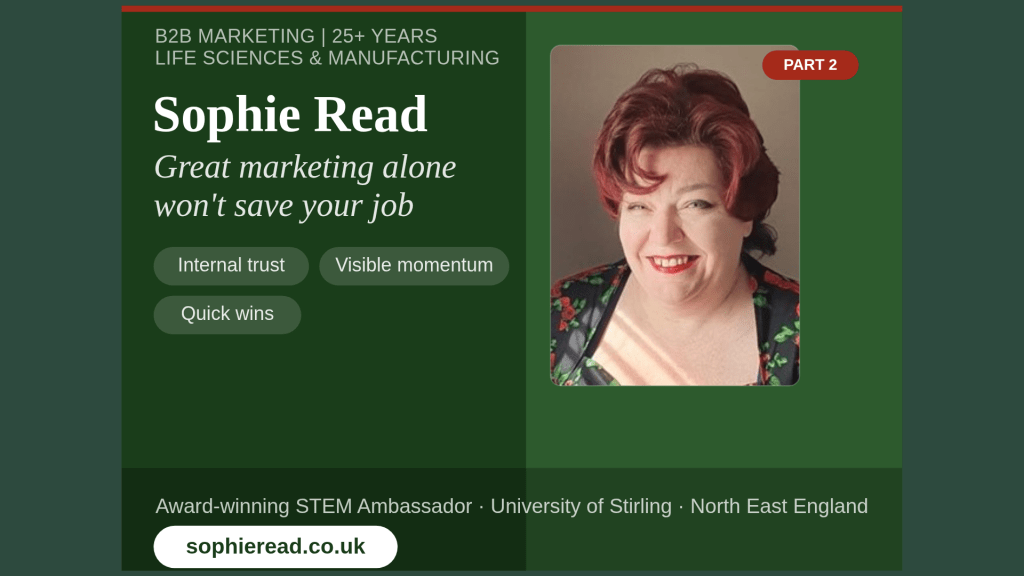
The lesson I kept having to relearn across 25 years, from global manufacturers to pharmaceutical CROs to life sciences software
Early in my career, I thought the job was mostly about building great campaigns, SEO, thought leadership, long-form content. The kind of slow, compounding work that takes twelve months to show results and then quietly becomes your most effective channel.
I still believe that work matters enormously. Probably more than most organisations are willing to invest in, honestly. But it took me longer than I’d like to admit to understand something that sits alongside it something that doesn’t appear in any marketing textbook and rarely comes up in job interviews.
“Part of the job is making the rest of the company feel confident in marketing.”
That sounds almost embarrassingly simple when you write it out. But the implications are significant and I’ve watched talented marketers lose their footing, their budgets, and eventually their roles because they never quite grasped it.
What’s Actually Happening
While you’re building the long-term engine, this is what everyone else is thinking
Marketing rarely operates in isolation. At any given moment, while the team is deep in content calendars and campaign builds, here’s what’s happening elsewhere in the building:
📊 The executive team is trying to justify headcount
Budget decisions get made in rooms marketing is rarely invited into. If the visible output of your function isn’t clear, those conversations don’t go well. “We’re playing a long game” is not a line that lands well when the CFO is looking at the cost centre.
🤝 Sales is wondering if marketing is actually helping them
Not abstractly – concretely. Do they have useful content for their conversations? Are the leads any good? Does the website say what they’re saying in front of prospects? If the answer to those questions is murky, the relationship between marketing and sales deteriorates quietly and then very suddenly.
📉 The founder or CEO is stressed about this quarter
Growth targets have a way of compressing everyone’s time horizon. When a quarter goes badly, long-term programmes start looking like luxuries. The marketer who has nothing to show except a twelve-month roadmap is in a much more precarious position than the one who has demonstrable wins on the board, even small ones.
💬 Customer success wants something useful to send
They’re in conversations with existing customers every day. They need content that works in those conversations not content optimised for search or designed around a demand generation funnel. If they’re not finding anything useful in the content library, they stop looking.
The Cave Problem
What “trust the process” looks like from the outside
I’ve seen it happen and if I’m honest, I’ve been part of it. Marketing can retreat into a carefully built programme, communicating in quarterly updates, and asks for patience while the compounding effects kick in. The work is good. The thinking is sound. But the rest of the organisation starts getting nervous.
Nervous organisations make short-term decisions. Budgets get cut. Headcount gets questioned. The eighteen-month content strategy gets replaced with something that will “show results faster.” And the marketer who built the programme finds themselves defending work that nobody internally has seen evidence of yet.
The cave approach
- Focused entirely on long-term output
- Communicates in quarterly reviews
- Asks colleagues to “trust the process”
- Measures success twelve months out
- Delivers everything at once or not at all
- Invisible internally until launch day
The visible approach
- Combines long-term with early quick wins
- Makes progress visible in real time
- Gives sales something useful this week
- Celebrates small milestones openly
- Launches things people can see working
- Builds internal confidence continuously
The irony is that the cave approach often produces better marketing. But it doesn’t always produce better outcomes because if nobody internally believes in what marketing is doing, you sometimes don’t get the runway needed to see it through – From My Own Career
What this looked like across very different organisations
I’ve worked in environments where this played out in very different ways. At CMP Products a global cable management manufacturer with regional sales teams across fourteen countries the marketing team’s credibility with the commercial organisation was built almost entirely on usefulness. Did the international sales teams have what they needed? Did product launches reach the right distributors at the right time? The long-term brand work mattered, but it was the day-to-day responsiveness that built trust with a global salesforce operating across six continents.
Arcinova (now Quotient) · Pharmaceutical CRO · Alnwick
At Arcinova, the commercial pressure was intense. A fast-growing PE-backed CRO with growth targets that were measured in quarters, not years. The award wins CPhI, BioNow, BVCA, Ward Hadaway Fastest 50 weren’t just external recognition. They were internal proof points. Every award announcement reinforced to the leadership team that marketing was generating visible, credible commercial momentum. The long-term content and positioning work happened alongside it. But the awards gave everyone something concrete to point to.
At Firefinch Software, working with technically sophisticated buyers in life sciences and manufacturing, the challenge was different again. The sales cycle was long and the product was complex. Marketing’s job wasn’t just to generate awareness it was to give the sales team credible, technically accurate materials that could survive scrutiny from R&D directors and quality managers. Usefulness to sales was the primary measure of success, and rightly so.
“Sophie has great attention to detail and marketing acumen. She really understands how to support a commercial team effectively. “
Mark Chadwick, Chief Commercial OfficerArcinova
That kind of feedback doesn’t come from building a great content programme in isolation. It comes from being genuinely useful to the people around you making their conversations better, their proposals stronger, their internal updates more credible – What I’ve Learned
How to build confidence while building the engine
The goal isn’t to abandon long-term marketing thinking. It’s to make sure you’re doing enough visible, useful work alongside it that the organisation stays confident while the compounding effects develop. Here’s what that looks like in practice.
1 – Create visible momentum in the first 90 days – always
Whatever organisation you join, find something you can ship quickly that makes someone else’s job easier. A sales deck that actually reflects how the product is being sold. A case study that customer success can actually use. A piece of content that answers the question prospects keep asking. Not because it’s the most strategically important thing but because it builds the trust you’ll need to do the strategically important things later.
2 – Treat internal communication as part of the job
A campaign that launches without anyone internally knowing it launched is a missed opportunity. Not because you need praise, but because visibility builds confidence. Share what you’re working on. Show the thinking, not just the output. Make it easy for the exec team to understand what marketing is doing and why in their language, not marketing language.
3 – Understand what sales actually needs – not what you think they need
Spend time with sales. Real time, in calls, in proposal reviews, in deal debriefs. The gap between what marketing produces and what sales uses is usually wider than either side realises, and the only way to close it is to understand the actual commercial conversation, not the version that appears in the product positioning document.
4 – Use award campaigns and external recognition strategically
External validation is one of the most effective ways to build internal confidence in marketing. When Arcinova won the CPhI Pharma Award or the BioNow Export Award, it wasn’t just good PR, it gave the exec team and the board something concrete to point to. It made the commercial story more credible. Identify the awards that matter in your sector and make entering them part of your annual plan.
5 – Name the tension – don’t pretend it doesn’t exist
The tension between long-term brand building and short-term commercial pressure is real in almost every B2B organisation. The marketers who navigate it best are the ones who name it explicitly, who can say, clearly and without defensiveness, “here’s what we’re building for the long term, here’s what we’re doing to help this quarter, and here’s how we’re balancing both.” That kind of clarity is reassuring to leadership in ways that a detailed content strategy rarely is.
The Point
Long-term marketing matters. So does the organisation’s belief in it.
None of this means abandoning the work that actually builds commercial momentum over time. SEO compounds. Thought leadership builds authority. A well-positioned brand makes every other marketing activity more efficient. That work is real and it matters.
But it works best when the organisation around you is confident enough in marketing to let it run and that confidence isn’t given freely, it’s built through usefulness, visibility, and the steady accumulation of wins that people can actually see.
Across 25 years working in B2B environments from global manufacturers and defence contractors to pharmaceutical CROs and life sciences software companies the marketers I’ve seen struggle most weren’t the ones who lacked technical skill. They were the ones who underestimated how much of the job is about maintaining the organisation’s belief in what they’re doing.
It took me longer than I’d like to fully internalise that. I hope it takes you less time.
What’s the most effective thing you’ve done to build internal confidence in marketing especially early in a new role? I’d genuinely like to know.
#B2BMarketing #MarketingLeadership #CareerAdvice #MarketingStrategy #SalesAndMarketing #LifeSciences #Manufacturing #NorthEastEngland #WomenInMarketing #B2B #CMO #MarketingROI #MaketingStrategy #GeneralistMarketer #Pharma


Leave a Reply