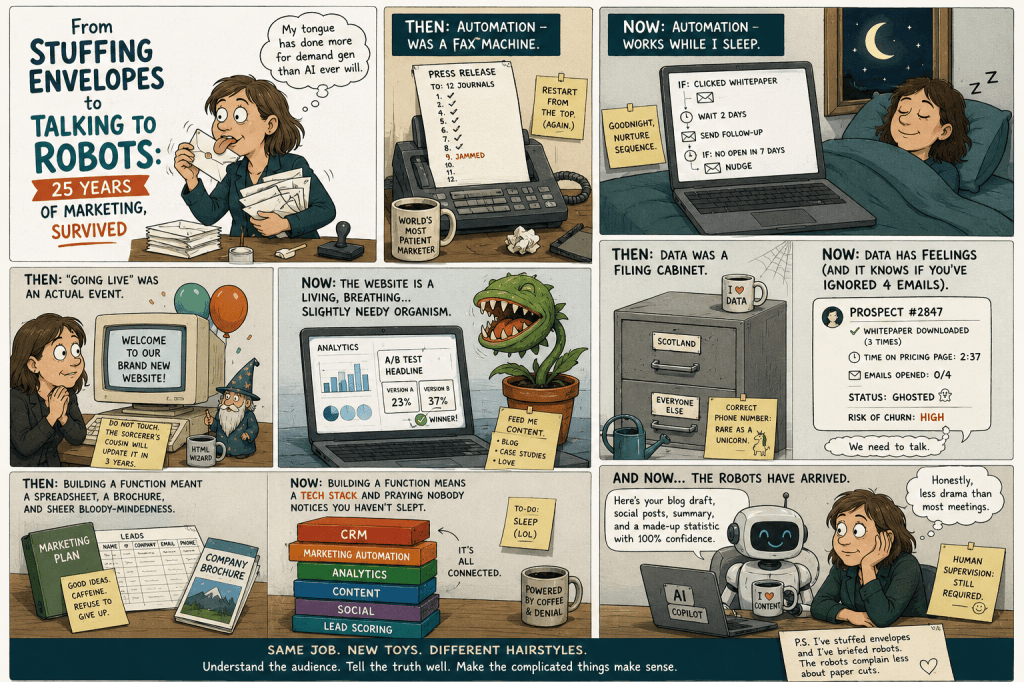
From Stuffing Envelopes to Talking to Robots: 25 Years of Marketing, Survived
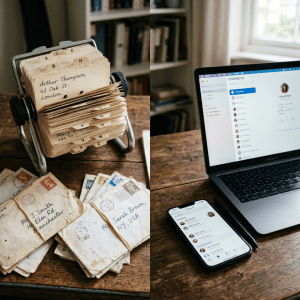
In 2000 I graduated from Stirling with a shiny new marketing degree and absolutely no idea that I was about to spend the next quarter of a century getting paper cuts.
Because that’s how it started. Not with a strategy deck. Not with a “brand purpose workshop.” With envelopes. Hundreds of them. Stuffed, licked, stamped, and sent off into the world on the strength of a mailing list pulled from an ACT! database that someone had clearly built by hand, one contact card at a time, possibly using a quill.
If you’re too young to remember ACT!, congratulations, and also: it was basically a digital Rolodex that crashed if you looked at it wrong. We treated it like the crown jewels. We had a whole ritual around “cleaning the database,” which mostly meant discovering that Dave from Purchasing had left the company in 1997 and nobody had told the marketing team.
Here’s what’s genuinely changed since then. And what, alarmingly, hasn’t.
The fax machine was our automation platform

Before “marketing automation” was a category with its own Magic Quadrant, we had a fax machine and a prayer. Sending a press release to twelve trade journals meant twelve individual fax transmissions, and if the machine jammed on number nine you started again from the top, swearing quietly, like a Victorian factory worker but with worse posture.
Now I can build a nurture sequence in HubSpot that reacts to what someone clicked, watches, or ignored, and quietly follows up while I’m asleep. The fax machine could not do this. The fax machine could barely dial the right number.
“Going live on the website” used to be an event

Early in my career, launching a new company website was A Whole Thing. There was a launch date. There were nerves. Someone’s cousin had “done some HTML” and we treated him like a sorcerer. The website, once launched, stayed almost entirely the same for about three years, because changing it meant emailing the sorcerer’s cousin and waiting.
Now I can update a page, push it live, check the analytics, and A/B test the headline before lunch. We went from “the website is a brochure we occasionally dust” to “the website is a living, breathing, slightly needy organism that requires constant attention.” I’m not sure this is better for my stress levels, but it’s certainly better for conversion rates.
Data went from “a filing cabinet” to “a personality trait”

In the ACT! era, data meant a name, a company, and if you were lucky, a correct phone number. Segmentation meant “the ones in Scotland” and “everyone else.”
Now, in life sciences and regulated manufacturing especially, I can tell you exactly which whitepaper a prospect downloaded, how long they lingered on the pricing page, and whether they’ve opened the last four emails or quietly ghosted us like a bad Tinder date. This is either the most powerful thing to happen to B2B marketing or faintly terrifying, depending on the day. Often both, before 10am.
Building a marketing function used to mean building an address book. Now it means building a tech stack.
I’ve been the “first marketing hire” more than once in my career, walking into companies with brilliant engineering and precisely zero marketing infrastructure. In 2007, building a function from scratch meant a spreadsheet, a company brochure, and sheer bloody-mindedness. In 2021, doing the same job meant standing up a CRM, marketing automation, analytics, content, social, and a lead-scoring model, ideally before anyone noticed you hadn’t slept.

The tools multiplied. The core job didn’t: translate something complicated into something someone actually wants to read, and prove it worked.
And now, the robots have arrived

Which brings us to now. AI has quietly become the new colleague nobody formally hired but everyone relies on. It drafts, it summarises, it occasionally hallucinates a statistic with total confidence, which, if I’m honest, is not wildly different from some agency briefings I’ve sat through over the years.
The genuinely new thing isn’t that AI exists. It’s the pace. The gap between “new tool launches” and “everyone’s using it, badly, in a LinkedIn post” is now measured in weeks, not years. In 2000, adopting a new piece of marketing technology was a multi-year procurement saga involving three approvals and a man called Graham from IT. In 2026, I can be testing a new AI tool for content ideation before my coffee’s gone cold.
What hasn’t changed at all
Here’s the bit that actually matters. Underneath the ACT! databases, the fax machines, the CRMs, and now the AI copilots, the actual job has stayed stubbornly the same: understand the audience, tell the truth well, and make the complicated things make sense. Whether that’s translating pharmaceutical CDMO capabilities for a scientist, or offshore engineering credentials for a procurement lead, the tools changed completely and the craft didn’t move an inch.
I’ve stuffed envelopes and I’ve briefed AI agents. Honestly, the AI agents complain less about paper cuts.
If you graduated around the same time as me, or you’re twelve years into a career and wondering why the “veterans” get misty-eyed about database software, I’d love to hear what you remember from the early days. And if you’re newer to the industry: yes, we really did fax things. On purpose. Repeatedly.


Leave a Reply